УКРАЇНА ПОЧИНАЄТЬСЯ З ТЕБЕ!
Методичні рекомендації для проведення Першого уроку в 2018/2019 навчальному році
ЩО ОЗНАЧАЄ БУТИ МУЖНІМ? WHAT DOES COURAGE LOOK LIKE? (урок-роздум для учнів 9-11 класів)
М.Г. Луценко, заступник директора, учитель англійської мови Благовіщенського НВК № 1 «Гімназія - ЗЗСО - ЗПО «Сонечко» Благовіщенської районної ради Кіровоградської області
Objectives:
By the end of the lesson, students will be able to:
• describe contemporary heroes who stand up for what they believe in.
• explore and develop an understanding of the concept of courage.
• identify their own attitudes and beliefs about courage.
• isolate examples of courage in current events and in their own lives
• evaluate examples of courage in the context in which they occurred.
• use visual history testimony to examine the courageous actions and deeds of others during the Holocaust.
• Students identify individuals in their own lives who embody heroism and think about the various roles people play in conflicts.
Equipment needed: • White board, chalkboard, projector.
Materials needed: • testimony clips: Testimony - Courage • Student Handouts: Mind map of Courage, Many Kinds of Courage
Procedure
I. Introduction
A. The teacher greets students and starts out a short dialogue.
B. Introduction of the topic.
Teacher: Glad to meet you, dear boys and girls! I am very happy to see you at our lesson. How are you getting on today? What shall we do today? Your task is to watch a very short video and guess what the theme for today’s lesson is.
• Watching a motivational short film “Courage”
(Students’ answers.)
Teacher: You are right. The topic of our lesson is “What Does Courage Look Like?”
Teacher: What is Courage? The word courage comes from the French root word, “coeur” which means heart. To have courage may be defined as “strength of heart.”
Get warmed up! Check your knowledge!
Aim: to get students ready to perceive the information on the topic, to introduce them the task of the lesson, to check their knowledge on the topic
• Have students discuss the following question with a partner. Ask: “If you had a superpower that you could use for good, what power would it be, and why?” Allow students a few minutes to share their thoughts. Ask for volunteers to share their responses with the class. Write the responses on a chart, making note of key descriptors. Then ask students what makes a hero different from a superhero. Chart responses, focusing on words that describe a hero’s qualities.
• Distribute the Student Handout: Mind map of Courage to each student. Ask students to individually think about the idea of courage and to complete as much of the web as possible. Allow a few minutes for students to record their responses. Divide the class into pairs. Students should compare their responses and assist one another in completing their individual webs.
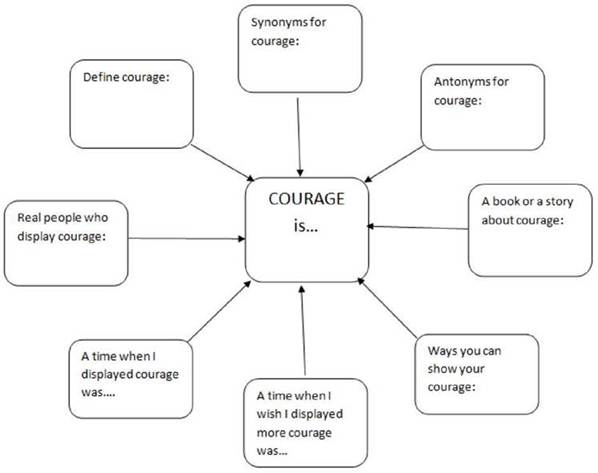
II. Main body
Speaking. Round table discussion
Aim: to discuss how someone turns a weakness into strength & develop key speaking skills
• On a Roll
Show the class a piece of paper. Ask them, “Is there any way the paper can hold up the book, using only one hand to hold the paper? You can ask for several volunteers to try; soon they will realize there is no way. Now take the paper and roll it tightly into a tube, the diameter of about 4-5 centimeters. Hold the tube in one hand and carefully place the book on top of the open end of the tube. It should support the book. Relate this to the ability we all have to turn our weaknesses into strengths and show courage. The paper at first seems flimsy, weak and easy to crush. This might be compared to some people who are faced with a problem or obstacle, they may lack the courage to confront the problem or stand up to the opposition. But, with determination we can turn our weaknesses into strengths. Just as the paper can be rolled into a sturdy tube, we can practice courage despite our doubts if we have the courage to try. Ask the students to give examples of how someone turns a weakness into strength.
Teacher: Analyze your family and the roles they are playing focusing specifically on what they are encouraging each other to do and not to do.
• Many Kinds of Courage
Aim: Brainstorm with students the many kinds of courage we need in different situations. Organize the brainstorming session into categories as seen in the chart below.
Teacher: Courage comes in many shapes, sizes and forms. While racing into a burning building to save lives and helping out a person who is being robbed are certainly courageous and admirable acts, even smaller occurrences can count as acts of courage. For example, confronting a bully or asking out a secret crush out on a date both require certain levels of bravery. Therefore, acts full of courage can happen on the grand scale, but also on the smaller, day to day life level.
(Distribute the Many Kinds of Courage handout to students. Ask students to write one example of courage that is most meaningful them and describe why they have chosen their specific example of courage.)
|
Grand Acts of Courage |
Ex: Mother Teresa living amongst the poorest of the poor and helping them to thrive, learn and grow Ex: Jesus Christ continuing to follow his faith, beliefs and mission despite being hanged on a cross, brutally beaten and attacked |
|
Courage on a Daily Basis |
Ex: Asking for a promotion or a raise at work. |
|
Courage with Friends |
|
|
Courage in New Situations |
|
|
Courage When You Are Hurt |
|
|
Courage to Seek Help |
|
|
Courage When You Are Learning |
|
|
Courage to Help Someone Else |
• Quiz “Are You a Person of Courage?”
(Take this self-evaluation and decide for yourself.)
|
True |
False |
|
|
О |
О |
I stand up for what is right even if I stand alone. |
|
О |
О |
I don't cave in to negative peer pressure. |
|
О |
О |
Fear of failure does not prevent me from trying things. |
|
О |
О |
I am not afraid to express myself just because some people might disapprove. |
|
О |
О |
I work to solve problems without violence. |
|
О |
О |
I never intentionally ridicule, embarrass, or hurt others. |
I think I am / am not a courageous person because:
_____________________________________________________________
Watching the video and discussing it
Aim: to give practice in identifying main concepts in the text of the film unit, to teach students to perceive not only by listening but combine it with watching
Pre-watching
1. Is courage something you are born with or is it something you learn and develop?
2. What does courage look like? What does courage sound like?
3. Do you need courage every day or just once in awhile?
4. In what ways do people demonstrate courage in the stories you have heard or read?
5. In what ways do people you know demonstrate courage?
6. In what ways are these demonstrations of courage similar or different?
7. Is courage demonstrated in large heroic efforts? Is courage demonstrated in small ways? Explain.
While-watching
Inform students that they are about to watch testimony clips taken from testimonies given by Holocaust survivors and witnesses. Explain to students that the following clips are brief excerpts from longer interviews. Tell the students that as they are watching the video, they should look for actions that each survivor describes regarding courage. Students should write these actions in the “actions” column (http://sfi.usc.edu/#panel_1)
Distribute copies of the Student Handout: Viewing Guide - Courage.
|
Interviewee |
Action |
Explanation |
|
Joseph Lipshutz |
||
|
Luisa Haberfeld |
||
|
GysJansen van Beek |
Post-watching
After viewing the three testimony clips, students should write why they believe the action described by the interviewee is an example of courage. Students should record their answers in the “explanation” column. Then divide the class into pairs. Allow a brief opportunity for student pairs to share their responses written on the Student Handout: Viewing Guide.
Conduct a large class discussion using some or all of the following questions as a guide:
1. What were some of the examples of courage identified in the testimony clips?
2. In your opinion, were the people who performed these acts of courage ordinary people or extraordinary people? Explain.
3. What is the relationship between courage and fear? Can you be afraid and still be courageous? Can you be courageous without fear?
4. Why do you believe that Joseph Lipshutz agreed to join the underground group even though he knew he might be killed?
5. Luisa Haberfeld talks about the Warsaw Ghetto Uprising as a demonstration of dignity and courage. Do you agree or disagree with her description? Explain your reasoning. In what other ways might you characterize this event?
6. Gys Jansen van Beek describes the loading of people onto train cars for transport to a concentration camp. Gys was a young person who chose to help a young boy escape from the train. In what ways was that decision a courageous one? Why do you think he chose to help?
• Courage Tree
Create a courage tree with your students. Cut a large tree shape from brown or green craft paper. Distribute the apple shape handout to students. Ask students to write one characteristic of courage on an apple such as "trying new things," "doing what is right," and "standing up for your friend" and then cut out the apple shapes. Collect the apples from the students. When students demonstrate courageous behaviours described on an apple then the apple is tacked or glued onto the tree.
• Profiles in Courage
Have the students in groups identify acts of courage by people in the news or by people in your school or community. Then have each group make a presentation. What do these courageous people have in common? What are their differences? What can the students learn about themselves from these people?
III. Summary
1. Home assignment
Choose one of the following quotes and explain why you either agree or disagree with the quote. In your response, reference your own experiences, the experiences exemplified in the testimony clips viewed, and/or the outcomes and insights garnered from class activities and class discussions of courage.
Ø "We must build dikes of courage to hold back the flood of fear."
Martin Luther King, Jr.
Ø “Courage is doing what you’re afraid to do. There can be no courage unless you’re scared.”
Eddie Rickenbacker (Fighter Pilot)
Ø ourage is resistance to fear, mastery of fear, not absence of fear.
Mark Twain
Ø The only real prison is fear, and the only real freedom is freedom from fear.
Aung San Suu Kyi (Democratically elected leader of Burma)
2. Evaluation of the lesson
Resources:
1. https://witsprogram.ca
2. http://sfi.usc.edu/#panel_1
3. www.learningtogive.org
4. http://examples.yourdictionary.com
5. www.onecommunityglobal.org